Structural Drying in Los Angeles, CA
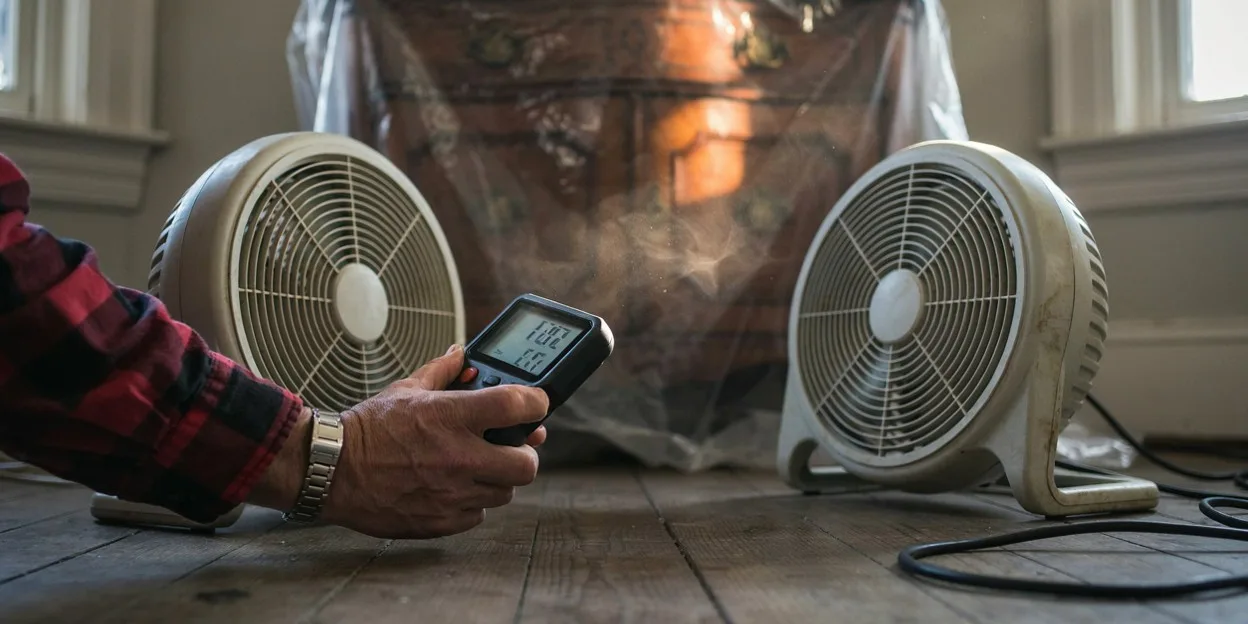
The puddle is gone. You mopped it up two days ago, but the baseboard in the hallway is starting to bubble and the room still smells like a wet towel. This site connects you by phone with an independent local provider who does structural drying in Los Angeles County.
What the crew does first
Before any equipment is set, the crew maps what is wet. A moisture meter on the drywall, the sill plate, and the subfloor tells them how far the water traveled. Thermal imaging can show cool patterns behind paint that point to where a closer reading is needed. That map is the drying plan.
Then the equipment goes in. Air movers push air across wet surfaces so moisture can leave the material. Dehumidifiers pull that moisture out of the room air so it does not settle back into the walls. Without the dehumidifier, the fans only move damp air around.
Most drying runs three to five days. The equipment is loud and it needs to stay on. Turning it off at night adds days.
What to do in the next hour
Make sure the source is fixed. Drying a wall while a leak keeps feeding it is wasted effort. If you are not sure where the water came from, say so on the call. Leak detection may need to come first.
If there is still standing water, that comes first too. See water extraction. Otherwise, pull furniture a foot or two off the wet wall and lift rugs off the floor. Do not paint over stains or set a box fan in the doorway and call it done. Take photos of any swelling, staining, or lifted flooring.
What is usually saved and what is not
Framing, plywood subfloor, and concrete almost always dry in place. Drywall that got wet from a clean source and was caught early can often dry in place too. The crew pulls the baseboard and drills small holes at the bottom of the wall to move air through the cavity. Solid hardwood is a maybe. A drying mat system can sometimes pull moisture out of the boards.
Wet insulation inside a wall does not dry well and usually comes out. Particleboard swells once and stays swollen. Ask the crew for a daily reading log so you can watch the numbers come down.
Los Angeles County notes
LA is dry most of the year, which helps. But a June gloom morning or a home near the coast in Santa Monica or the South Bay can sit near 80 percent humidity. Opening windows does not dry a wall under those conditions. The dehumidifier does.
A lot of LA housing is post-war stucco over wood framing on a slab. Stucco does not breathe much, so water inside the wall stays there. Slab homes also mean water under a floating floor has nowhere to go.
Many policies cover sudden water damage. Gradual leaks often are not. Ask the crew to record moisture readings before and after so your adjuster can see what was wet and when it was dry. Rebuild work that replaces framing or moves plumbing in the City of Los Angeles usually needs a permit from LADBS. Other cities in the county have their own building departments.
Calling about structural drying
Have the address and the date of the water event. Be ready to say whether the source is fixed, which rooms and materials are wet, and whether anyone has already opened walls or removed flooring. Say if the home is a condo, since equipment may need to run in a neighbor's unit too. Call (000) 000-0000.